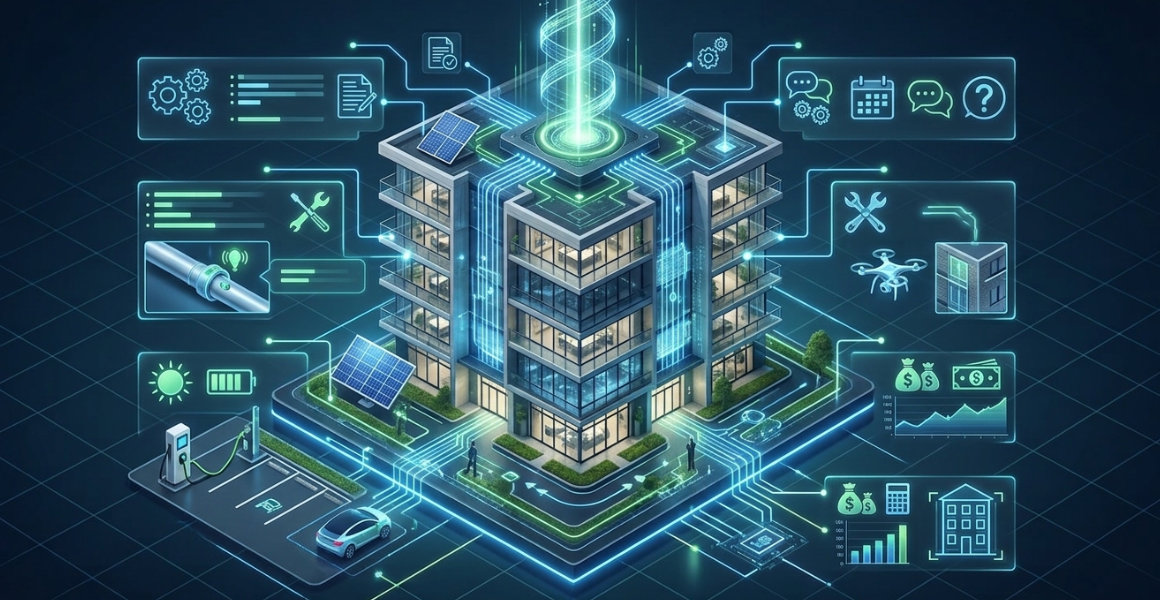
Artificial intelligence (AI) is rapidly transforming industries across Australia, and strata living is no exception. While strata management has traditionally relied on manual processes and time-consuming admin, AI has the potential to help strata schemes operate more efficiently while improving the experience for owners and residents alike.
AI, however, should be viewed as a tool that supports better decision-making. Human expertise will always remain essential in strata management.
Streamlining day-to-day administration
One of the most immediate benefits of AI in strata management is its ability to reduce time spent on repetitive administrative tasks.
Strata Committees deal with large volumes of documentation, emails, meeting preparation and owner communication. Digital tools can now assist with:
- drafting meeting agendas
- preparing minutes from committee meetings and AGMs
- summarising long email chains
- creating by-law notices
- generating maintenance updates
- and preparing resident communications
AI can quickly turn meeting notes into structured minutes, helping reduce administrative workload while improving consistency and efficiency. Some AI tools can also automatically transcribe meetings, identify key decisions and generate action lists to help committees track follow-up tasks more efficiently.
AI may also assist committees by summarising and comparing contractor quotes, helping identify pricing differences, missing scope items or inconsistencies between proposals.
More efficient resident communication
Communication is one of the most important aspects of strata management, but it can also be one of the most time-consuming.
Automated tools are helping streamline communication by assisting with:
- resident enquiries
- maintenance updates
- meeting reminders
- by-law information
- frequently asked questions
These systems can provide faster responses to common questions while helping residents access information more efficiently. AI can also help categorise and prioritise incoming requests so urgent issues are escalated more quickly.
AI translation tools may also help strata schemes communicate more effectively with owners from diverse language backgrounds by translating notices and simplifying technical information.
Strata schemes may even implement AI assistants or “AI agents” that help owners access common information about the building, by-laws, maintenance requests or meeting schedules more efficiently. These systems may also assist residents with booking common facilities, organising move-ins or accessing building-related information more conveniently.
Predictive maintenance and smarter building management
One of the most promising applications of AI in strata management is predictive maintenance.
Traditionally, many strata maintenance issues are addressed only after a problem becomes visible or disruptive. Water leaks, lift issues and electrical faults can escalate into larger and more expensive repairs if not identified early.
Smart monitoring systems are changing this approach by analysing building data in real time to identify patterns and potential risks before failures occur. Sensors installed throughout a building can detect abnormalities such as unusual water usage, temperature fluctuations or equipment performance changes.
For example, smart leak detection systems installed in apartment buildings can automatically alert building managers to unusual water usage before a major leak occurs.
These systems can then flag potential maintenance issues early, helping strata committees and building managers take proactive action.
AI-assisted defect detection
AI is also beginning to play a role in defect identification and building inspections.
Advanced image recognition technology can analyse photographs and drone footage to identify cracks, water damage, façade deterioration or other building defects that may otherwise go unnoticed during routine inspections.
As many NSW apartment buildings continue to age and compliance expectations increase, AI-assisted inspections may become an important tool in helping owners corporations identify risks earlier and maintain buildings more effectively.
Smarter energy monitoring and sustainability
As sustainability becomes a growing priority across NSW apartment buildings, AI is also helping strata schemes better understand and manage energy consumption.
Energy monitoring systems can analyse electricity usage patterns across common areas and building infrastructure to identify inefficiencies and opportunities for savings.
For example, AI may help optimise:
- lighting schedules
- air-conditioning usage
- EV charging infrastructure
- water consumption
- and solar energy utilisation
These insights can support more sustainable building operations while potentially reducing long-term operational costs for owners corporations.
Financial forecasting and levy planning
Financial planning is another area where AI may provide significant value in the future.
By analysing historical maintenance data, building age, contractor costs and market trends, AI systems may help forecast future capital works requirements more accurately.
This could support:
- improved sinking fund forecasting
- more accurate levy planning
- earlier identification of major expenses
- and reduced reliance on unexpected special levies
If you have additional questions about implementing efficiencies using AI, please contact your Strata Manager at Netstrata.